
Premium handling for Delaware residences, estates, artwork, antiques, and valuable furnishings.


Elate Moving offers across its different branches, catering to the diverse needs of residential, commercial, fine art, international, and government clients
 Step 1: Initial Planning
Begin by creating a detailed moving plan, including a timeline, checklist, and inventory of items to be moved.
Image: Display a visual of a moving checklist with key items listed.
 Step 2: White Glove Packing
Hire professional packers for a white glove packing service. They will carefully pack and label each item, ensuring the utmost protection during transit.
 Step 3: Loading
Professional movers will load your items onto the moving truck with precision. Heavy items go on the bottom, and fragile items are secured properly.
 Step 4: Transportation
The moving truck will transport your items securely to the new location. Provide information on estimated travel time and any unique features of the transportation service.
 Step 5: Unloading
Upon arrival, movers will carefully unload your items, ensuring that nothing is damaged during the process. They will follow a floor plan for efficient placement.
 Step 6: White Glove Unpacking
White glove unpacking involves professionals unpacking and arranging items according to your specifications. This includes setting up furniture and organizing belongings.
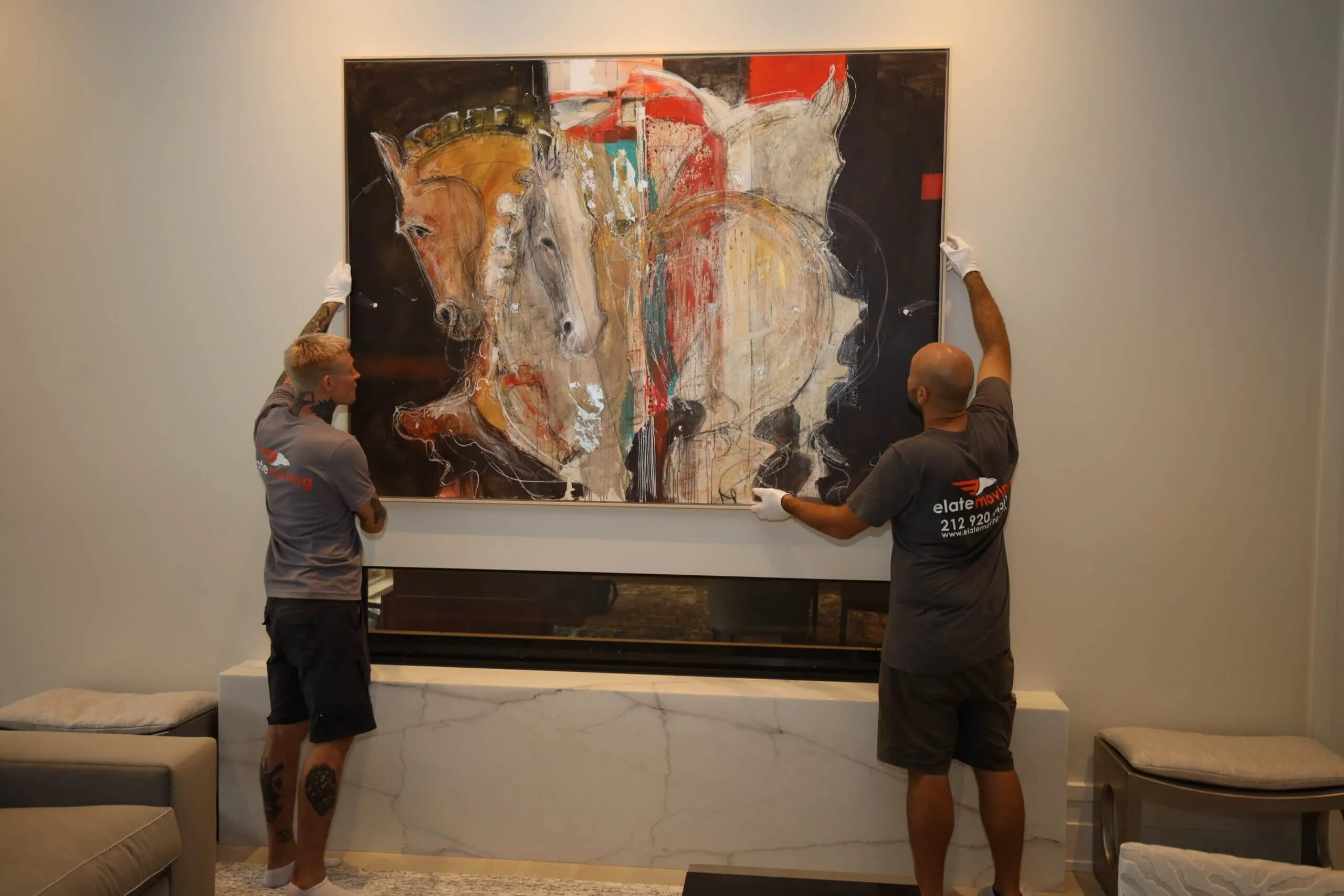 Step 7: Final Touches
Conduct a final walkthrough with the movers to ensure everything is in its place. Address any concerns or specific requests.
 Step 8: Post-Move Follow-up
Follow up after your move for a smoother experience! Share your valuable feedback or let us know if you have any post-move concerns that need attention.

Custom Art Crating Services

Installation Services

Express Local & Long Distance Art Logistics

Art Storage

Wood shipping crates

Please provide us details for your move. Its free and takes only 30 seconds
Elate Moving offers across its different branches, catering to the diverse needs of residential, commercial, fine art, international, and government clients

Founder, President, CEO, Chairman

Just moved from my apartment on Central Park South to New Jersey. George and his crew from Elate Moving were so great to work with! So professional and courteous. As a Real Estate Broker-Associate for Sotheby’s Prominent Properties International Realty I will be referring this wonderful moving company to all my clients. They truly exceeded my expectations!!!!

Elate Moving provided excellent service from the second I called them through the completion of the move. They showed up on time, came prepared (with packing supplies, blankets and other tools), were nice and efficient. They also provided the best quote out of all the movers I called. Highly recommend their services for your next move.
The two gentlemen arrived in their 20 foot truck a half hour early today. That was excellent! These guys packed everything up neatly. They got it all on the truck in a more organized manner than I could’ve ever imagined. Absolutely phenomenal service
We're here to help and answer any question you might have


A move can become complicated long before the first box is loaded. A glass dining table may need a different packing plan from the rest of the room. A tall cabinet may fit its new space but not the stair turn leading to it. Artwork, finished furniture, large mirrors, and decorative pieces may also require more preparation than standard household goods.
For customers planning these types of moves, Elate Moving offers white glove moving services focused on the items, access conditions, packing decisions, and destination placement that need extra coordination. White glove moving is not simply a more expensive version of a standard move. It is useful when selected belongings require a specific handling plan rather than being treated as part of a general household inventory.
Request a quote with your preferred move date, origin and destination, property type, approximate inventory, and any pieces that need additional attention. Photos and dimensions of large, fragile, or unusual items can help define the scope.
Not every item in a home needs the same level of preparation. Many white glove moves contain ordinary household goods plus a smaller number of pieces that require more detailed planning.
Examples may include a glass table, antique cabinet, oversized mirror, sculpture, framed artwork, or furniture with delicate finishes. Cost alone does not determine how an item should be handled. Size, shape, removable components, surface finish, fragility, and access can all matter.
Before requesting a quote, separate the inventory into standard household goods and items you want the mover to review individually. For the second group, note removable shelves, glass panels, loose parts, existing damage, or possible disassembly. This gives a moving company more useful information than a broad description such as “high-end furniture.”
When comparing high-end movers in Delaware, look at whether the quote process accounts for item dimensions, fragile finishes, removable components, and access conditions before the move is scheduled.
Dimensions matter twice: once for the item and once for the path it has to travel.
A sectional, armoire, headboard, or dining table may be easy to move inside a large room but difficult to take through a narrow doorway, tight hallway, stair landing, or elevator. The same issue can appear at the destination even when pickup access is straightforward.
For oversized pieces, provide approximate dimensions and photos of the main access points. Mention stairs, elevator use, long carries, narrow passages, or a loading position that is not close to the entrance. If a piece can be disassembled, it is better to identify that before moving day.
This is a practical difference between a standard residential move and a white glove move: the route becomes part of the handling plan, not just the item.
Packing does not have to be all-or-nothing.
Some customers pack clothing, books, kitchen items, and ordinary boxes themselves while leaving artwork, mirrors, glass components, decorative objects, or finished furniture for the movers to prepare. Others prefer broader packing or unpacking support.
Define that scope before the quote is finalized. If an item already has original packaging or a fitted case, mention it. If a piece has an unusual shape, delicate surface, loose elements, or visible existing damage, provide photos so the mover can understand what needs to be considered.
Artwork should also be listed separately instead of being grouped into a general category such as “wall decor.” If paintings, framed works, or similar pieces are an important part of your move, review Elate Moving’s fine art moving services for additional information.
White glove residential moving may involve more than bringing furniture inside the destination. Large or delicate pieces can have specific room or placement requirements.
That affects unloading order. A heavy table intended for the back of a dining room may be easier to place before chairs, boxes, and smaller furniture occupy the path. A cabinet going upstairs should not be left on the first floor simply because its destination was not confirmed. Repositioning heavy or fragile pieces later adds handling that may have been avoidable.
Room labels, a simple floor plan, or written placement notes can make this clearer. If a designer, property manager, building representative, or another person will make placement decisions, identify who should be available to approve the location of key pieces.
For private-home moves in Delaware, destination planning can be especially useful when only a few items have precise placement requirements while the rest of the inventory can be unloaded normally.
A useful white glove moving quote should describe the work, not only the number of bedrooms.
Include the origin and destination, preferred date, property type, and approximate inventory. Then identify the items that require individual attention. Photos and dimensions are especially useful for oversized furniture, mirrors, artwork, glass pieces, or objects that may need disassembly.
Also include practical access information such as stairs, elevators, long carries, narrow doorways, or other conditions that could affect the work. State whether you want packing, unpacking, furniture disassembly or assembly, and room-specific placement.
Pricing can depend on inventory volume, packing requirements, delicate or oversized pieces, access conditions, disassembly needs, origin and destination, and placement requirements. A detailed inventory gives the mover a better basis for discussing the job than a general request for “luxury moving.”
The reason to choose white glove moving is not simply that the belongings are expensive. It is that some parts of the move need to be planned individually.
One household may contain only a few pieces that require special packing, route planning, disassembly, or exact placement. Another may involve a larger group of artwork, finished furniture, mirrors, or decorative objects. Identifying those requirements early helps clarify which services belong in the quote.
Elate Moving can review the inventory, access details, packing needs, and placement requirements for a Delaware move and prepare a quote based on the requested scope. Send your move date, origin and destination, property type, approximate inventory, photos of large or fragile items, and any known handling concerns to start the conversation.
Frequently Asked Questions (FAQ)
Question: What does white glove moving include for homes and high-value items in Delaware?
Answer: White glove moving can include specialized packing, furniture wrapping, disassembly and reassembly, careful handling of artwork and antiques, and room-by-room placement at the destination. The service scope depends on the inventory, item values, access conditions, and whether custom packing or crating is needed.
Question: What is the typical cost of a white glove move in Delaware?
Answer: A white glove move in Delaware may cost about $200–$400+ per hour for a multi-person crew, while larger residential moves are commonly estimated as a complete project. Pricing can change based on packing labor, materials, specialty items, travel distance, crew size, stairs, elevators, and difficult loading access.
Question: How early should I schedule Delaware white glove movers for a large home or estate?
Answer: Scheduling 2–4 weeks ahead is reasonable for many white glove moves, while larger estates or moves involving extensive packing may benefit from additional lead time. Advance planning gives more time to document the inventory, identify specialty items, coordinate access, and confirm any property-management requirements.
Question: How do parking, elevators, and long carries affect a white glove move in Delaware?
Answer: Limited parking, elevator reservations, stairs, gated entrances, and long distances between the truck and residence can increase labor time and affect the moving plan. Sharing these details before the estimate helps determine crew requirements, equipment needs, and a more realistic schedule.
Question: What should I ask about insurance and COI requirements before a white glove move?
Answer: Ask what coverage applies to your belongings and whether a certificate of insurance can be provided when a condo, apartment building, or property manager requires one. You should also confirm any building-specific coverage limits, wording, or additional-insured requirements before moving day rather than assuming every property uses the same rules.
Question: How should artwork, antiques, and designer furniture be prepared for a white glove move in Delaware?
Answer: Artwork, antiques, glass, and designer furniture should be identified before the move so the appropriate wrapping, padding, boxes, or custom crating can be planned. Providing dimensions and photos in advance is especially useful for oversized pieces, delicate finishes, narrow entrances, and items that may need disassembly.
Your opinion is very important to us
We have received your application and will contact you as soon as possible
Stay up to date with our updates
You'll receive an email with the certificate details and instructions on how to use it within the next 24 hours.
$ 150
$ 200


