
Detailed relocation planning for New Hampshire homes, estates, fine furniture, and delicate items.


Elate Moving offers across its different branches, catering to the diverse needs of residential, commercial, fine art, international, and government clients
 Step 1: Initial Planning
Begin by creating a detailed moving plan, including a timeline, checklist, and inventory of items to be moved.
Image: Display a visual of a moving checklist with key items listed.
 Step 2: White Glove Packing
Hire professional packers for a white glove packing service. They will carefully pack and label each item, ensuring the utmost protection during transit.
 Step 3: Loading
Professional movers will load your items onto the moving truck with precision. Heavy items go on the bottom, and fragile items are secured properly.
 Step 4: Transportation
The moving truck will transport your items securely to the new location. Provide information on estimated travel time and any unique features of the transportation service.
 Step 5: Unloading
Upon arrival, movers will carefully unload your items, ensuring that nothing is damaged during the process. They will follow a floor plan for efficient placement.
 Step 6: White Glove Unpacking
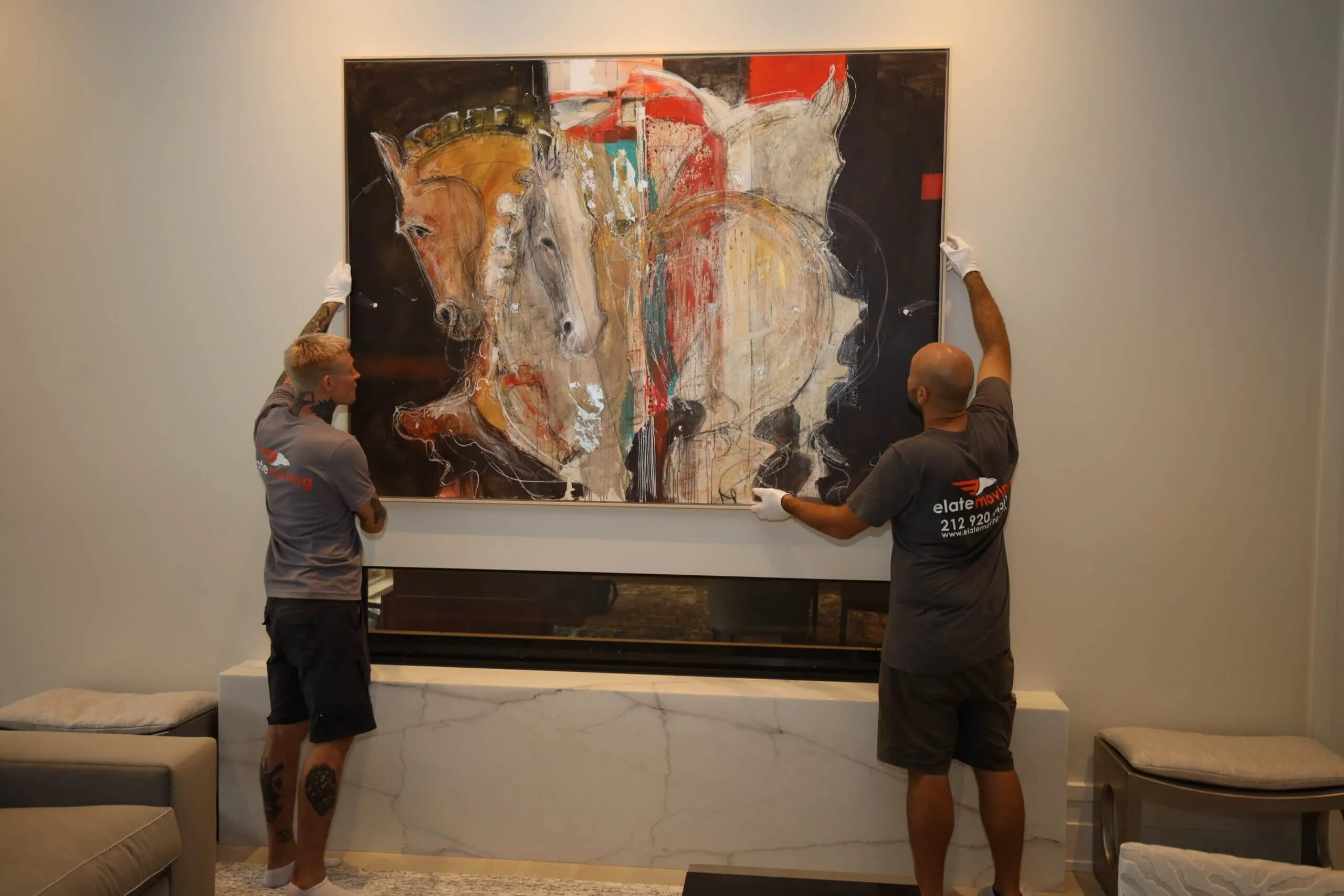
White glove unpacking involves professionals unpacking and arranging items according to your specifications. This includes setting up furniture and organizing belongings.
 Step 7: Final Touches
Conduct a final walkthrough with the movers to ensure everything is in its place. Address any concerns or specific requests.
 Step 8: Post-Move Follow-up
Follow up after your move for a smoother experience! Share your valuable feedback or let us know if you have any post-move concerns that need attention.

Custom Art Crating Services

Installation Services

Express Local & Long Distance Art Logistics

Art Storage

Wood shipping crates

Please provide us details for your move. Its free and takes only 30 seconds
Elate Moving offers across its different branches, catering to the diverse needs of residential, commercial, fine art, international, and government clients

Founder, President, CEO, Chairman

Just moved from my apartment on Central Park South to New Jersey. George and his crew from Elate Moving were so great to work with! So professional and courteous. As a Real Estate Broker-Associate for Sotheby’s Prominent Properties International Realty I will be referring this wonderful moving company to all my clients. They truly exceeded my expectations!!!!

Elate Moving provided excellent service from the second I called them through the completion of the move. They showed up on time, came prepared (with packing supplies, blankets and other tools), were nice and efficient. They also provided the best quote out of all the movers I called. Highly recommend their services for your next move.
The two gentlemen arrived in their 20 foot truck a half hour early today. That was excellent! These guys packed everything up neatly. They got it all on the truck in a more organized manner than I could’ve ever imagined. Absolutely phenomenal service
We're here to help and answer any question you might have


A white glove move is usually defined less by the number of rooms than by the items that can change the plan. A home may contain ordinary cartons, standard furniture, framed artwork, a polished dining table, a glass-front cabinet, antiques, or pieces that are difficult to replace. Treating all of that as one general household inventory can hide the details that matter most.
Elate Moving provides white glove moving services for customers planning New Hampshire moves that require item-specific preparation, packing decisions, access planning, disassembly or assembly, and destination placement. The goal is not to add the same “premium” treatment to every box. It is to identify the belongings and logistics that need a different approach before moving day.
To request a quote, send your preferred move date, origin and destination, property type, approximate inventory, and a short list of any artwork, antiques, delicate furniture, oversized pieces, packing needs, or access conditions that should be discussed separately.
A room count is useful for describing the size of a move, but it does not explain which belongings may need additional planning.
Consider a bedroom with boxed clothing, two lamps, a large upholstered headboard, a mirrored dresser, and a fragile decorative piece. The cartons may be straightforward. The dresser may need to be measured against the route out of the room. The headboard may need to be taken apart before it can clear an entrance. The decorative object may need to be packed separately instead of being grouped with general decor.
This is where residential white glove movers in New Hampshire differ in scope from a conventional household move. The planning focuses on the exceptions: pieces whose size, surface, construction, fragility, value, or intended placement changes how they should be prepared.
A household with only a few high-value pieces does not necessarily need every item handled the same way. Identifying those exceptions early can make the plan more specific without adding unnecessary services to the rest of the inventory.
A cabinet can fit comfortably in its current room and still create a problem at the doorway, on a staircase, or at the destination. That is why dimensions and access should be considered together.
Useful details may include narrow entrances, multiple flights of stairs, elevator access, long carries, limited loading areas, or a large piece that must reach an upper floor. These conditions should be described for both the origin and destination.
A dining table offers a simple example. Removing its legs may solve the exit route at the current residence, but the reassembled table still needs to fit the intended room and the route leading to it. Sharing approximate measurements and access photos before moving day can help determine whether disassembly, reassembly, or a different placement plan should be discussed in advance.
For customers comparing a white glove moving company in New Hampshire, this kind of pre-move preparation says more about the service scope than vague promises about “extra care.”
White glove packing is not simply a larger amount of packing material. Different objects create different preparation questions.
Framed artwork, glass, polished wood, stone surfaces, delicate upholstery, antiques, and ordinary boxed goods should not automatically be treated as one packing category. A glass-front cabinet may need different preparation from a dining table with removable components. A framed piece should be identified separately instead of appearing on an inventory only as “wall decor.”
Customers with significant artwork can also review Elate Moving’s fine art moving services for more information about that type of move.
Packing support can be selective. Some households may need help only with artwork, glass, or delicate furniture, while others may want broader packing or unpacking assistance. The question is which belongings require additional preparation—not whether every carton should receive the same handling.
Large, delicate, or difficult-to-reposition pieces are easier to manage when their final rooms are decided before they enter the property.
A cabinet intended for an upstairs office should not first be placed downstairs simply because the destination was unclear. A heavy table should not need to be carried through the home twice because its location was decided after unloading.
Room labels, a simple floor plan, or written placement notes can reduce those last-minute decisions. Customers can also identify which pieces may need assembly before they are positioned.
This is relevant for private-home moves with multiple rooms or a mix of standard furniture and pieces that should be placed deliberately. The distinction is not only how an item is carried; it is also how much of its route and destination has been considered in advance.
A standard residential move may be appropriate when most belongings can be packed, moved, and placed using routine procedures. White glove service becomes more relevant when the move contains enough exceptions that a basic inventory no longer describes the work well.
That may include high-value furniture, artwork, antiques, fragile pieces, difficult access, planned disassembly, or specific room-placement requirements. It may also apply when only part of the household inventory needs additional attention.
People searching for high-end movers in New Hampshire or luxury movers in New Hampshire are often comparing companies for these reasons. Rather than focusing on luxury terminology, compare what the move actually requires: which pieces need separate preparation, what access needs to be checked, whether packing support is needed, and what should happen after delivery.
The scope of a white glove move can be affected by inventory, item dimensions, packing requirements, access at each property, distance, disassembly or assembly needs, and requested placement or unpacking.
A useful quote request should include the preferred move date, origin and destination, property type, approximate household inventory, and any items that deserve separate attention. Add dimensions or photos for unusually large pieces, note stairs or elevator access, and explain whether artwork, antiques, delicate furniture, or other fragile belongings are involved.
You do not need a perfect inventory before making contact. Start with the pieces most likely to change the plan.
If you are evaluating New Hampshire white glove movers, request an estimate from Elate Moving with those details. A clear description of the move, special items, access conditions, and placement requirements gives the quote discussion a practical starting point.
Frequently Asked Questions (FAQ)
Question: What does a white glove move in New Hampshire usually include?
Answer: White glove moving typically includes protective packing, careful handling of high-value furnishings, furniture disassembly and reassembly, and placement at the destination. The exact scope can vary depending on the home, inventory, artwork, antiques, and other specialty items involved.
Question: How much do white glove movers in New Hampshire typically cost?
Answer: White glove moving services in New Hampshire may cost about $200–$350+ per hour for a multi-person crew, while larger or long-distance moves may be quoted as a flat or project-based price. Cost is affected by crew size, packing materials, inventory volume, travel distance, stairs, driveway access, and specialty handling.
Question: How early should I schedule a white glove move in New Hampshire?
Answer: Booking 2–4 weeks in advance is a practical target for many white glove moves, while larger or more complex relocations may require 4–6 weeks of preparation. Additional planning time is useful when the move includes custom packing, valuable artwork, multiple residences, or coordination with building or property managers.
Question: What access details should I give movers before a white glove move in New Hampshire?
Answer: Provide details about long driveways, steep grades, narrow roads, stairs, gated entrances, parking limits, and any areas where a moving truck may have difficulty reaching the home. These conditions can affect vehicle choice, crew size, carrying distance, equipment, and the overall estimate.
Question: How should artwork, antiques, and high-value furniture be handled during a New Hampshire white glove move?
Answer: Fragile and high-value pieces should be identified before the estimate so appropriate wrapping, padding, crating, or specialty handling can be planned. Ask how each item will be protected, what valuation or coverage options are available, and whether either property requires a certificate of insurance.
Question: Do seasonal conditions affect white glove moves at New Hampshire homes?
Answer: Yes, snow, ice, mud, steep private roads, and limited winter access can change how a white glove move is planned. Movers may need to account for longer carrying distances, alternate vehicle access, extra floor protection, or schedule adjustments based on the property’s conditions.
Your opinion is very important to us
We have received your application and will contact you as soon as possible
Stay up to date with our updates
You'll receive an email with the certificate details and instructions on how to use it within the next 24 hours.
$ 150
$ 200


