
Careful moving for Vermont estates, country homes, artwork, antiques, and premium furnishings.


Elate Moving offers across its different branches, catering to the diverse needs of residential, commercial, fine art, international, and government clients
 Step 1: Initial Planning
Begin by creating a detailed moving plan, including a timeline, checklist, and inventory of items to be moved.
Image: Display a visual of a moving checklist with key items listed.
 Step 2: White Glove Packing
Hire professional packers for a white glove packing service. They will carefully pack and label each item, ensuring the utmost protection during transit.
 Step 3: Loading
Professional movers will load your items onto the moving truck with precision. Heavy items go on the bottom, and fragile items are secured properly.
 Step 4: Transportation
The moving truck will transport your items securely to the new location. Provide information on estimated travel time and any unique features of the transportation service.
 Step 5: Unloading
Upon arrival, movers will carefully unload your items, ensuring that nothing is damaged during the process. They will follow a floor plan for efficient placement.
 Step 6: White Glove Unpacking
White glove unpacking involves professionals unpacking and arranging items according to your specifications. This includes setting up furniture and organizing belongings.
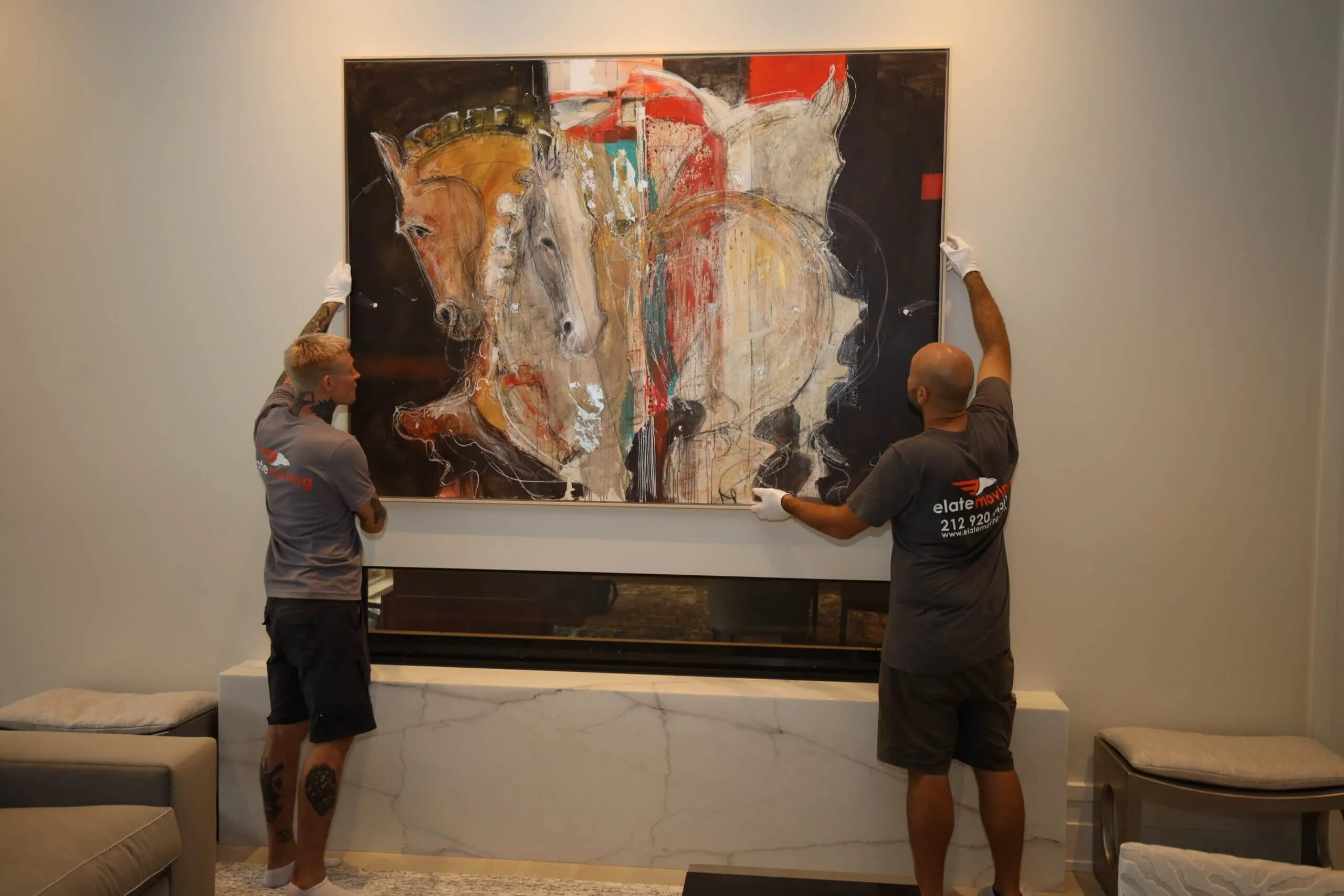 Step 7: Final Touches
Conduct a final walkthrough with the movers to ensure everything is in its place. Address any concerns or specific requests.
 Step 8: Post-Move Follow-up
Follow up after your move for a smoother experience! Share your valuable feedback or let us know if you have any post-move concerns that need attention.

Custom Art Crating Services

Installation Services

Express Local & Long Distance Art Logistics

Art Storage

Wood shipping crates

Please provide us details for your move. Its free and takes only 30 seconds
Elate Moving offers across its different branches, catering to the diverse needs of residential, commercial, fine art, international, and government clients

Founder, President, CEO, Chairman

Just moved from my apartment on Central Park South to New Jersey. George and his crew from Elate Moving were so great to work with! So professional and courteous. As a Real Estate Broker-Associate for Sotheby’s Prominent Properties International Realty I will be referring this wonderful moving company to all my clients. They truly exceeded my expectations!!!!

Elate Moving provided excellent service from the second I called them through the completion of the move. They showed up on time, came prepared (with packing supplies, blankets and other tools), were nice and efficient. They also provided the best quote out of all the movers I called. Highly recommend their services for your next move.
The two gentlemen arrived in their 20 foot truck a half hour early today. That was excellent! These guys packed everything up neatly. They got it all on the truck in a more organized manner than I could’ve ever imagined. Absolutely phenomenal service
We're here to help and answer any question you might have


One or two pieces can change the requirements of an otherwise conventional household move.
A cabinet may fit comfortably in a room but be too tall to turn on the staircase. A large framed work may need to be described separately instead of being grouped with ordinary wall décor. A dining table may have been assembled after it entered the home and may need to be discussed before moving day.
Elate Moving provides white glove moving services for Vermont customers whose moves involve belongings, access conditions, packing requirements, or destination placement that deserve more individual planning than a standard household inventory provides.
To request an estimate, send your preferred move date, origin and destination, approximate household inventory, and photographs or descriptions of any artwork, fragile pieces, oversized furniture, unusual construction, or items that may need to be taken apart before removal.
Bedroom count helps establish the size of a move, but it does not show which belongings may require separate decisions.
Consider two homes with similar inventories. One contains mostly cartons, conventional furniture, and pieces that can move through the existing entrances without additional discussion. The other contains a large mirror, a glass-front cabinet, several framed works, a sectional assembled from multiple components, and a table that may not clear the stairs in one piece.
Those moves may look similar on a basic inventory but require different preparation.
For white glove moving, it is useful to separate ordinary household contents from the smaller group of pieces that could affect packing, disassembly, removal, loading, or placement. This is one of the main differences between a detailed high-end residential move and a quote based almost entirely on room count.
Descriptions such as “artwork,” “living-room furniture,” or “two cabinets” may not provide enough information when an individual piece could affect the moving plan.
Large framed works, mirrors, antiques, delicate finishes, glass components, collectibles, unusually shaped furniture, and oversized pieces are better identified separately.
Useful information can include:
A framed piece, for example, may be more useful on the inventory as “large framed artwork with glass, approximately 60 × 48 inches” than simply “picture.”
Customers moving a significant artwork collection can also review Elate Moving’s fine art moving services for information focused specifically on art-related moves.
The dimensions of the item are only half of the question. Its route through the property matters too.
A tall piece may clear a doorway but fail to turn beneath a low ceiling near a staircase. A sectional may fit through the front entrance only after its sections are separated. Furniture that was assembled inside a bedroom may not leave that room in its current form.
Before requesting a quote, it can help to check the likely removal path for anything unusually large. Doorways, hallways, landings, stair turns, and floor changes are the most useful areas to flag.
The same applies to access outside the residence. If the loading position may be some distance from the entrance, or vehicle access near the property may be limited, mention that during the quote discussion. These details can be evaluated as part of the move rather than discovered only after the crew arrives.
A household can contain mostly straightforward belongings and still benefit from white glove planning.
Ordinary cartons, clothing, books, kitchen items, and conventional furniture may be easy to describe in a standard inventory. At the same time, a small number of pieces may require separate photographs, dimensions, packing discussions, or placement instructions.
That distinction is useful for private homes, furnished second homes, and seasonal residences in Vermont where the customer may want the move planned around a smaller number of sensitive or difficult belongings rather than treating the entire household as one undifferentiated premium package.
For customers comparing high-end movers or luxury movers in Vermont, this type of item-specific planning can be more useful than treating the entire household as one undifferentiated premium package.
White glove moving does not automatically mean that every possession requires the same packing approach.
The useful question is which items should be discussed individually before packing begins.
Glass pieces, mirrors, framed artwork, delicate decorative objects, and furniture with sensitive surfaces may warrant more discussion than ordinary household cartons. Other customers may primarily need help with packing a particular room, unpacking selected belongings, or preparing a group of fragile pieces.
Providing photographs and approximate quantities during the estimate helps clarify what packing assistance you want included rather than leaving the scope undefined.
Destination placement can change how a large piece should be approached.
A cabinet intended for a first-floor room presents a different question from the same cabinet going upstairs. A large mirror that will remain packed temporarily has different placement requirements from one that needs to reach a specific room immediately.
For furnished residences and private-home moves, a simple destination plan can be useful. Note which floor and room should receive the larger, heavier, or more delicate pieces.
It can also be worth checking the destination route before moving day. A piece may fit the room perfectly but still fail to clear the doorway, hallway turn, or staircase leading to it.
A useful request gives enough information to identify the parts of the move that deserve individual review.
Include:
You do not need to determine the solution to every moving question yourself. The objective is to show which belongings and property details may affect the scope so they can be discussed before the estimate is finalized.
Choosing a white glove moving company in Vermont makes the most sense when the move contains specific items or logistical details that deserve more than a general furniture count.
Elate Moving can prepare a quote around the actual contents and requirements of your move. Send your preferred timing, origin and destination, general inventory, and details about the pieces that may need individual planning.
Photographs, dimensions, packing requests, stairs, access notes, and intended placement are especially useful for oversized furniture, artwork, fragile items, and belongings that may be difficult to remove or position at the destination.
Frequently Asked Questions (FAQ)
Question: What services are typically included with white glove movers in Vermont?
Answer: White glove moving in Vermont typically includes detailed packing, furniture protection, disassembly and reassembly, careful handling of fragile or high-value belongings, and room-by-room placement at delivery. For antiques, artwork, designer furniture, or unusually large pieces, the estimate should identify any additional packing or handling requirements.
Question: How much does a white glove move in Vermont usually cost?
Answer: A Vermont white glove move may cost about $200–$400 per hour for a 2–4 person crew, while larger homes or specialty-item moves can cost more. The final estimate is usually affected by inventory volume, packing labor, travel distance, stairs, long carries, property access, and the number of items requiring extra protection.
Question: How early should I schedule white glove movers for a Vermont home?
Answer: For most Vermont white glove moves, booking about 2–4 weeks ahead provides useful planning time, while large estates or peak-season moves may benefit from 4–6 weeks of notice. Earlier scheduling allows time to review the inventory, packing needs, access restrictions, and any items that require special preparation.
Question: How do rural roads, long driveways, and limited truck access affect a Vermont move?
Answer: Rural access can change the equipment, crew time, and carrying plan needed for a white glove move in Vermont. Gravel roads, steep or narrow driveways, gates, limited turnaround space, and long distances between the truck and entrance should be disclosed before the estimate whenever possible.
Question: How are antiques, artwork, and other valuable items protected during a white glove move?
Answer: Valuable items can be individually wrapped, padded, boxed, or crated depending on their size, material, fragility, and replacement value. Before hiring a mover, ask how specialty items will be documented and handled, what valuation options are available, and whether a Vermont condo or managed property requires a certificate of insurance.
Question: What should I plan for when moving in Vermont during winter or mud season?
Answer: Winter and mud-season moves in Vermont require extra attention to road conditions, driveway access, snow, ice, and soft ground around rural properties. Discuss these conditions before moving day because weather or seasonal access can affect truck placement, carrying distance, loading time, and the overall moving plan.
Your opinion is very important to us
We have received your application and will contact you as soon as possible
Stay up to date with our updates
You'll receive an email with the certificate details and instructions on how to use it within the next 24 hours.
$ 150
$ 200


